The Night a Tornado Crossed Lake Erie: Cleveland's 1953 Disaster
On the evening of June 8, 1953, a tornado touched down in rural northwest Ohio and began moving east-northeast. It would not stop for 118 miles. By the time it crossed downtown Cleveland and disappeared into Lake Erie, 18 people in Ohio were dead, hundreds were injured, and entire blocks of the West Side were gone.
It was not the only tornado that night. The same storm system had already killed 116 people in Flint, Michigan. The next day, it would kill 94 more in Worcester, Massachusetts. In the span of two days, 245 people died across three states. 1953 remains one of the deadliest tornado seasons in American history.
118 Miles
The tornado first touched down near the village of Deshler, about halfway between Toledo and Lima. From there, it tracked east-northeast across Wood County, Sandusky County, Erie County, Lorain County, and into Cuyahoga County. It was on the ground for over two hours.
The West Side
The tornado entered Cleveland at the northwest corner of Hopkins Airport at 9:45 PM. From there it tore northeast through the West Side, running roughly parallel to Lorain Avenue.
The worst of it fell between West 117th and West 130th Streets south of Lorain, where houses were completely destroyed. The area around Franklin Circle was similarly devastated. St. Stephen Church lost its roof and windows. Downed trees and utility poles trapped streetcars and buses. Emergency vehicles could not get through.
On West 28th Street, rescuers pulled six bodies from the rubble of a single house, including a 13-month-old baby.
The tornado crossed the Cuyahoga River, shattered the storefronts along Euclid Avenue, and then moved out over Lake Erie near East 40th Street, where it finally dissipated.
In Cleveland alone, the storm killed at least 8 people, injured more than 300, and left over 200 homeless. Damage was estimated at $50 million, roughly $570 million in today's dollars.
The Response
Mayor Thomas Burke activated the National Guard and called an emergency cabinet session. The Red Cross set up shelter at Sts. Philip and James Catholic Church on Bosworth Road and deployed mobile canteens for rescue workers and displaced families.
The Red Cross later noted that its resources "were depleted, as 1953 was considered one of the worst tornado periods in history."
The Bigger Picture
The June 8 Cleveland tornado was part of what is now called the Flint-Worcester tornado outbreak sequence, one of the most destructive tornado events in American history.
- June 8, Flint, Michigan: An F5 tornado killed 116 people and injured 844. It remains one of the deadliest single tornadoes ever recorded in the United States.
- June 8, Ohio: The 118-mile F4 tornado killed 18 across multiple counties, including 8 in Cleveland.
- June 9, Worcester, Massachusetts: An F4 tornado killed 94 and injured nearly 1,300.
In the wake of the outbreak, the U.S. Weather Bureau reorganized its severe weather operations on June 17, 1953, creating the Severe Local Storm Center. That agency would eventually become the Storm Prediction Center, which issues every tornado watch and severe thunderstorm watch in the country today.
The 1953 outbreak is the reason the modern warning system exists.
The Photo
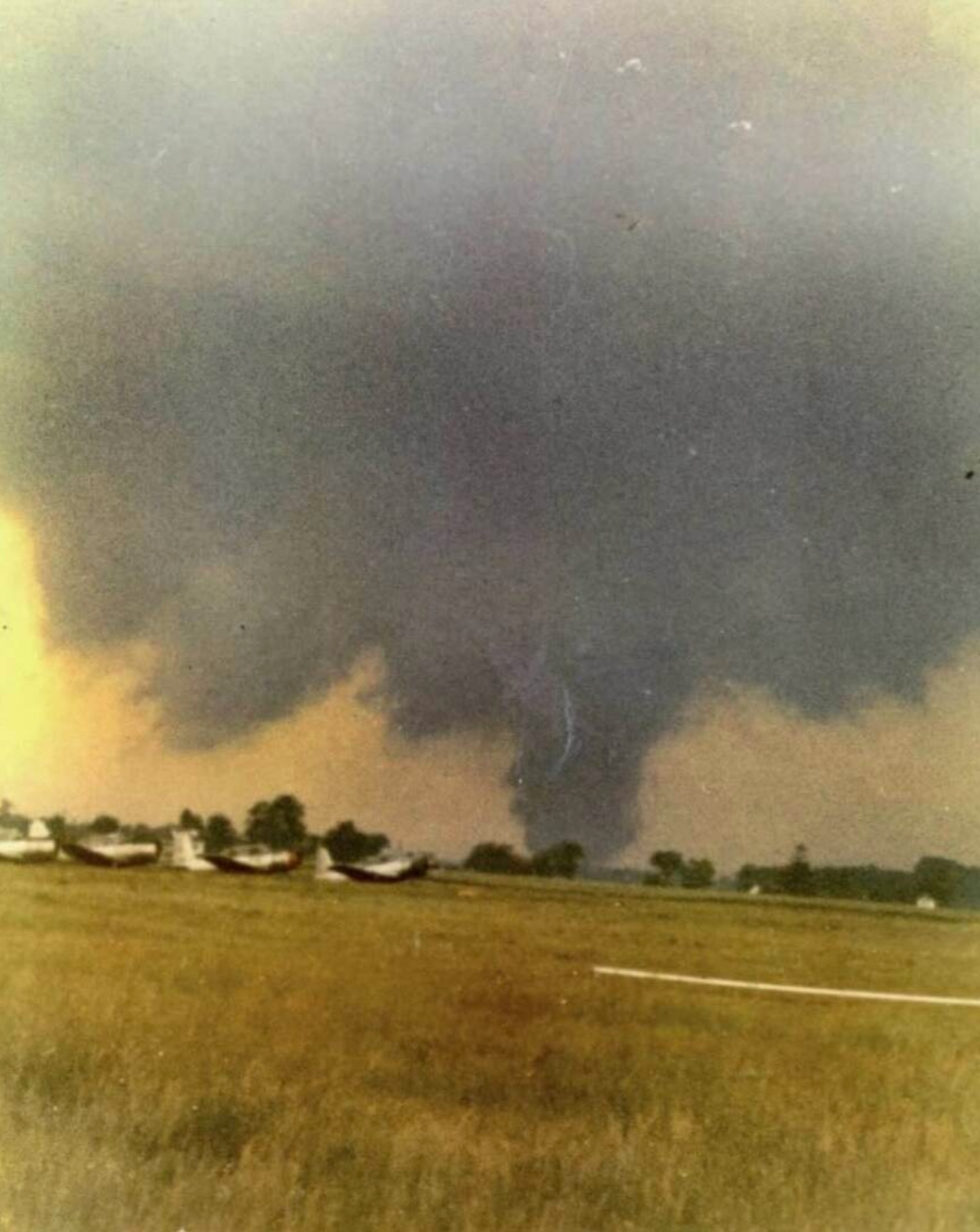
Perhaps the only publicly accessible photograph of the 1953 tornado shows it touching down near Cleveland-Hopkins Airport.
Tornado at Airport photo credit: Dick Goddard, via Lakewood Observer, June 8, 1953
Approximate path map credit: Cleveland Public Library, drawn on 1951 satellite imagery
---
Sources: Cleveland Historical; Encyclopedia of Cleveland History, Case Western Reserve University; U.S. Deadly Events Database; Storm Prediction Center; National Weather Service; Lakewood Observer; Cleveland Public Library.