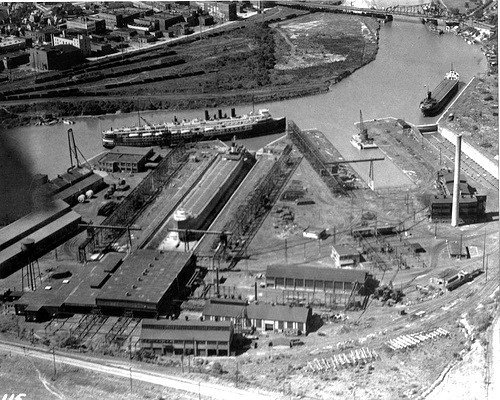
Aerial view of American Ship Building yards, looking northwest, 1952. Photo courtesy of the Lorain Public Library — Doane Historical Archives collection.
For 165 years, the banks of the Black River in Lorain, Ohio were one of the most important shipbuilding centers in America. The yard launched warships, ore carriers, passenger steamers, and the largest vessel ever to sail the Great Lakes. Then one December, it all went dark.
This is the story of the Lorain shipyards.
The Beginning: Wood, Water, and War
Lorain's shipbuilding story doesn't start with steel. It starts with two men, a destroyed business, and a government land grant.
1812
War Brings Shipbuilders West
The U.S. Government gave Augustus Jones and William Murdock land at the mouth of the Black River to rebuild their shipbuilding company from Connecticut, which had been destroyed during the War of 1812.
1819
Lorain's First Ship
The General Huntington, a wooden sloop, was launched on the Black River — Lorain's very first vessel and the start of what would become the city's defining industry.
1800s
300 Ships Before the Steel Age
Throughout the 19th century, private citizens along the Black River built roughly 300 wooden ships to meet the booming shipping demands of the Great Lakes.
The Steel Age Arrives
Everything changed in 1898 when industrial shipbuilding came to the Black River.
1898
Cleveland Shipbuilding Moves to Lorain
The Cleveland Shipbuilding Company relocated to the east bank of the Black River, bringing industrial-scale shipbuilding to Lorain. The facility boasted the largest dry docks on the Great Lakes. On April 13, they launched the Superior City — the first steel-hulled vessel built at the yard.
1900
American Ship Building Company Is Born
Cleveland Shipbuilding changed its name after acquiring yards in Superior (WI), Toledo (OH), and West Bay City (MI). The new company would dominate Great Lakes shipbuilding for the next 80 years.
WWI Era
Expansion Across the Lakes
The company acquired Buffalo Dry Dock (NY), Chicago Shipbuilding (IL), and Detroit Shipbuilding (MI) — becoming the undisputed giant of Great Lakes shipbuilding.
Tragedy: The White Hurricane of 1913
The Great Storm of 1913 was the deadliest natural disaster in Great Lakes history — and Lorain-built ships were at the center of it.
1909
SS Isaac M. Scott Launched
Built at the Lorain yard and launched June 12. A 504-foot steel freighter, she was nearly identical to her sister ship, the SS Charles S. Price, also built at Lorain in 1910.
Nov 1913
The White Hurricane
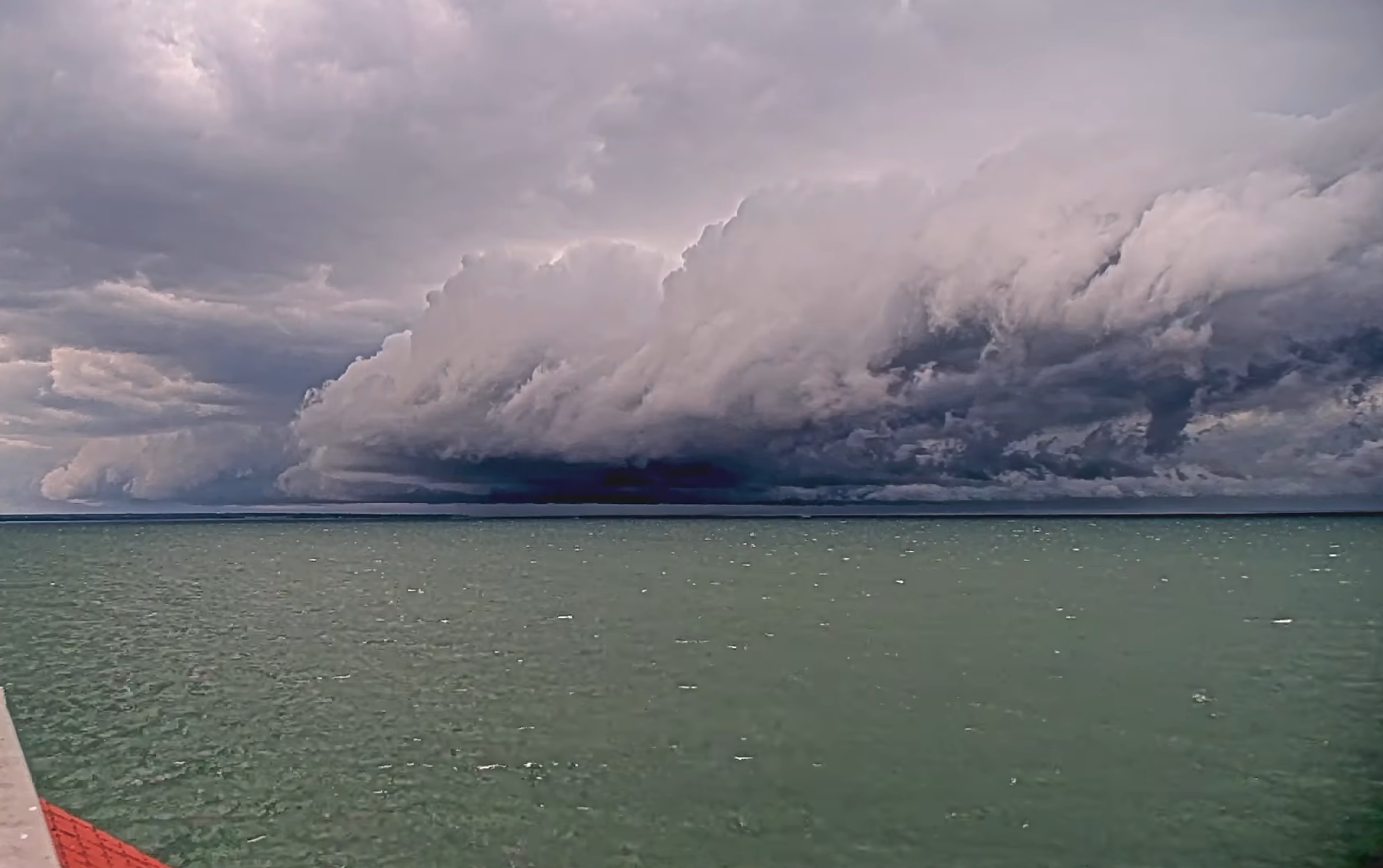
The Great Storm of 1913 — the deadliest in Great Lakes history — sank 12 ships, drove 31 ashore, and killed 248 sailors. Among the lost: the Isaac M. Scott and Charles S. Price, both Lorain-built. At least five Lorain-built ships were destroyed in the storm.
The Scott was found by divers in 1976, upside down under 180 feet of water off the coast of Michigan, half buried in mud. She'd been there for 63 years.
World War II: Lorain Builds for the Navy
When the war came, the Lorain yard answered.
1941–1944
35 Ships for the Navy
The Lorain yard pivoted to wartime production, building approximately 35 vessels for the U.S. Navy — minesweepers, net tenders, patrol craft, and cruisers, including the USS Lorain and USS Lorain County. The workforce swelled to over 2,500.
Wartime
188 Liberty Ships (New Orleans)
American Ship Building managed the Delta Shipbuilding Company in New Orleans, which built 187 Liberty ships and one other vessel. The company ranked 81st among all U.S. corporations in WWII military production contract value.
The Super Ship Era and Steinbrenner
After the war, Lorain became the premier yard for the biggest ships on the Great Lakes — and gained a famous (or infamous) new boss.
1952
Largest Shipbuilder on the Great Lakes
American Ship Building held the title of the biggest builder on the lakes. Lorain was the heart of operations, with two dry docks exceeding 1,000 feet long — large enough for the biggest ore carriers ever built.
1960s
The Super Ship Era Begins
The industry shifted toward massive 1,000-foot ore carriers. Five of the thirteen 1,000-footers ever built on the Great Lakes came out of the Lorain yard.
1967
Steinbrenner Takes Over
George M. Steinbrenner III — yes, that Steinbrenner — became chairman and CEO through his family's Kinsman Marine Transit Company. He would become far more famous as owner of the New York Yankees.
1976–1977
James R. Barker & Mesabi Miner
Two massive ore carriers launched from Lorain, continuing the yard's legacy of building the biggest ships on the lakes.
The End: December 1983
The final chapter was bitter.
Feb 1981
The Last Ship: 'Queen of the Lakes'
The MV William J. DeLancey (later renamed Paul R. Tregurtha) launched from Lorain — 1,013.5 feet long, the largest vessel ever to sail the Great Lakes. She could haul 68,000 tons of taconite. Nicknamed 'Fancy DeLancey' for her elevator and luxurious owner's quarters, she remains the Queen of the Lakes today.
1978–1979
Strikes Shut Down the Yard
Labor disputes between Steinbrenner and union workers over cost-saving concessions led to strikes that closed the Lorain, Toledo, and Chicago yards.
Dec 1983
1,500 Jobs Gone Before Christmas
Steinbrenner closed the Lorain shipyard and moved all operations to Tampa, Florida. Over 1,500 workers lost their jobs just weeks before Christmas, ending 85 years of shipbuilding on the Black River.
1993–1995
The Company Dies
American Ship Building filed for Chapter 11 bankruptcy in 1993 and was sold in 1995, ceasing all operations. The dominant force in Great Lakes shipbuilding for nearly a century was gone.
"Over 1,500 workers lost their jobs just weeks before Christmas, ending 85 years of shipbuilding on the Black River."
What Remains
2024
The Pattern Warehouse Lives On
Of the massive shipyard complex, only two structures survive: the water tower and the 25,000-square-foot Ship Building Pattern Warehouse — a red brick building now home to the Lorain Brewing Company and Event Center.
Today
HarborWalk Rises
The HarborWalk Residential Community now covers most of where the shipyard once stood. But the Black River still flows past, and the Queen of the Lakes — built right here — still sails.
The numbers tell the story: 909 ships built. 35 Navy vessels for WWII. Five of the thirteen 1,000-foot super ships ever built on the Great Lakes. The largest vessel still sailing today.
Not bad for a city that started with a wooden sloop named the General Huntington.
---
Sources: Lorain Brewing and Event Center historical records, Encyclopedia of Cleveland History (Case Western Reserve University), Wikipedia, Clio Historical Marker entries, Interlake Steamship Company, Remarkable Ohio Historical Markers. The Lorain Brewing Company and Event Center at 500 Shipyard Way preserves the history of the yard in the original Pattern Warehouse — worth a visit.